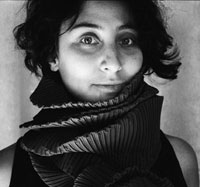
 Russian-born sculptor and installation artist, Julia Nitsberg, calls herself artist/provocateur and believes in the social function of art. For the last decade she has created multi-media sculptural installations, exploring a variety of moral, ethical, and socio-political issues as well as codes and preoccupations, ranging from the role of the mass media to the possibility of war and it’s anti-ecological nature. Following the example of her favorite art triangle: Marcel Duchamp, Andy Warhol and Joseph Beuys, she employs irony, speculation, criticism and romanticism. Industrial materials, mass production and their by-products play an important role in Julia Nitsberg’s work. The mutation of a cold, impersonal matter at human touch prevalent in the works of Alexander Calder, David Smith and Eva Hesse remains a constant subject of her fascination.
Since 1990 the artist became interested in public projects and site-specific public sculpture and proposed the construction of several outdoor monuments provoked by environmental issues of the largest NYC Municipal Garbage Dump “Fresh Kill”. The installations “Leaning Tower”,” The Ultimate Shopping”,” Room with a View”, addressed environmental issues such as man’s careless attitude towards nature and the future. The interactive installations: “Tabula Rasa”, “Landscape in the Interior”, “Between wind and water”, invited public participation.
After the initial shock from the disaster of 9/11 she turned to history, philosophy and literature in search for explanations and solace. “Post Factum”,” Merry, merry, quite contrary…” the memorial project, “MONUMENT: Urbi et Orbi” and the latest multi-media installation “The Eighth Day”, were reflections on the 2001, September 11 attacks on the World Trade Center and its aftermath.
In reaction to the escalating violence in the world, her focus has changed to nature and solitude. The installation “East of Eden”, “Add-dressing”, and the migrating international mural “Silver Flight” are reflections on natural surrounding and primordial memory.
But recently the artist returned to her search for a new millennium symbol of unity and lingua franca and questions the possibility of coexistence for cultures with diverse beliefs and ethics in a progressively borderless world. The traveling installation “Kotel” is a provocation for an intellectual quest for an alternative to Babylon, an emblem of violence, arrogance and fear.